Colibri: a small Brazilian-Portuguese embedding model with top-tier quality
Colibri is an embedding model for Brazilian Portuguese, developed in Brazil at the Federal Institute of São Paulo (IFSP). It has 151M parameters, small enough to run on a CPU, and on MTEB-BR v1 it scores 63.8 in the mean over task types: 7th among the 105 open models, and the best model up to 200M parameters by more than six points.
Colibri was developed by the author of MTEB-BR. It was trained only on data outside the evaluation sets and is evaluated with exactly the same pipeline as every other model on the leaderboard.
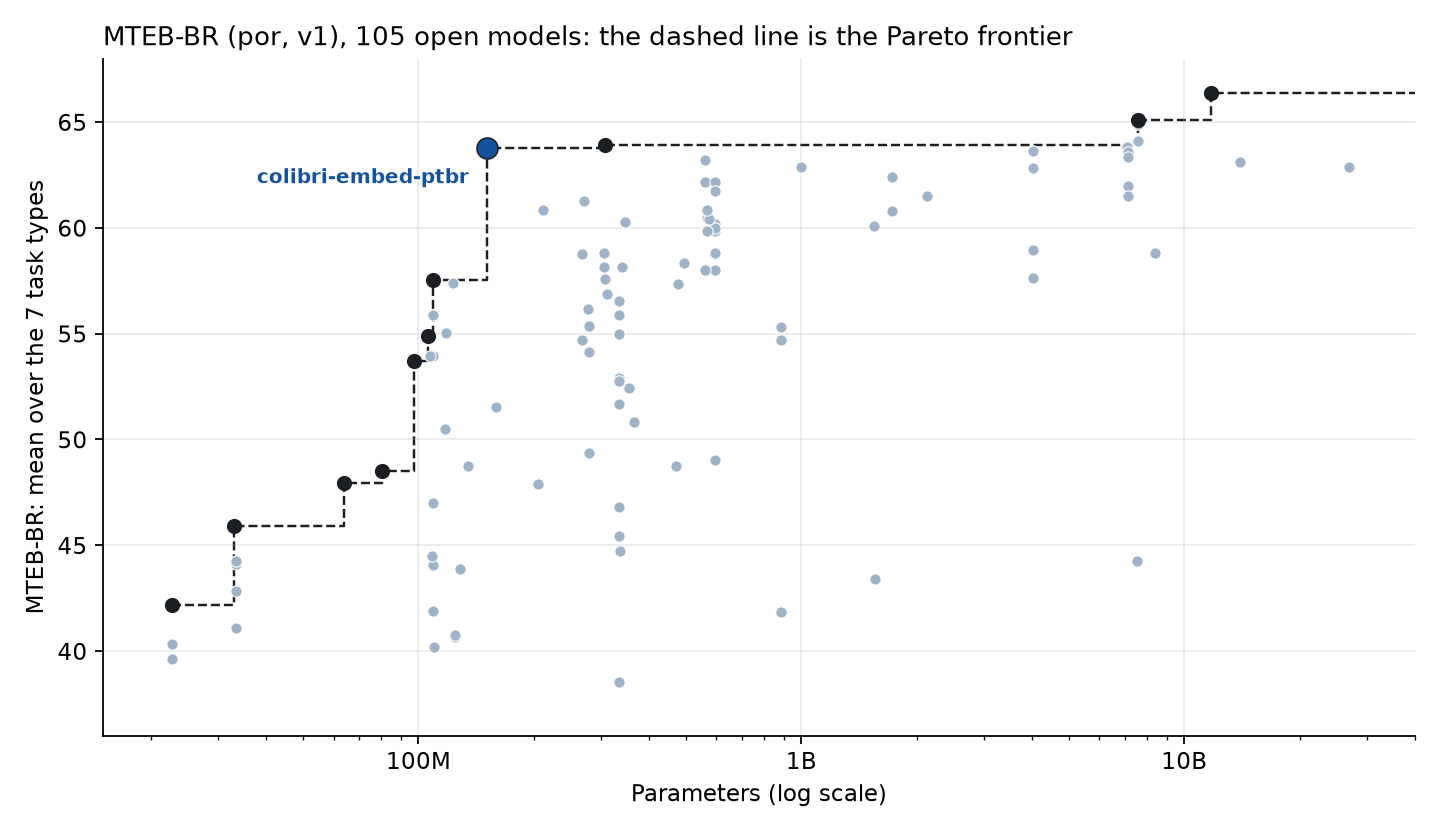
Top-tier quality at a fraction of the size
- 7th of 105 open models (14th of 125 counting commercial APIs). The six open models above it are five models of 7B to 12B parameters (KaLM-Gemma3-12B, Qwen3-Embedding-8B, Octen-8B, F2LLM-v2-8B and gte-Qwen2-7B) and a 308M model it is statistically tied with.
- Better than 69 of the 75 open models larger than it, including bge-m3, Qwen3-Embedding-4B, F2LLM-v2-14B and the 27B harrier-oss-v1.
- On the Pareto frontier: apart from a 308M model it is statistically tied with, every open model that scores higher has 7 billion parameters or more, about 50 times its size.
- Best up to 200M parameters by a wide margin: 63.8 against 57.5 for the next model.
First in its size class in every use case
The leaderboard has six use-case views that rank models on a subset of tasks. Among the 30 models up to 200M parameters, Colibri is first in all six:
| Use case | Colibri | Next model ≤200M | Rank among all models |
|---|---|---|---|
| Semantic similarity (4 tasks) | 83.1 | 82.3 | 11th of 125 |
| Academic (3 tasks) | 74.0 | 72.2 | 13th of 125 |
| Social media (4 tasks) | 63.8 | 60.8 | 16th of 125 |
| Legal (5 tasks) | 51.3 | 48.6 | 23rd of 125 |
| Medical (2 tasks) | 68.2 | 60.6 | 30th of 125 |
| Search / RAG (8 tasks) | 62.5 | 58.2 | 36th of 131 |
The strongest areas are semantic similarity and academic text, where it sits close to the top of the whole leaderboard. Search is where large models and the new late-interaction models pull furthest ahead; there a different kind of model is worth considering if quality matters more than cost.
Built for cheap hosting
Colibri was designed to run without a GPU. Measured on a 4-vCPU, 16 GB VPS:
- 32 ms per sentence with the ONNX backend.
- 229 MB of RAM as GGUF Q8_0 in llama.cpp, with the same embeddings as full precision (cosine 0.9996). It fits next to a local LLM.
- Matryoshka dimensions: vectors can be truncated to 512, 256 or 128 dimensions to save storage.
- Plain Sentence Transformers model: no adapters and no custom code.
from sentence_transformers import SentenceTransformer

model = SentenceTransformer("tardellirs/colibri-embed-ptbr")
q = model.encode("Como declarar imposto de renda de aluguel?", prompt_name="query")
d = model.encode(["Rendimentos de aluguel devem ser informados na ficha de Rendimentos Tributáveis..."],
                 prompt_name="document")
print(model.similarity(q, d))
How it was built
Colibri starts from Google’s EmbeddingGemma-300m and specializes it for Brazilian Portuguese in three steps:
- Vocabulary trimming. The 262k-token multilingual vocabulary is cut to about 64k tokens chosen for Brazilian Portuguese. Most of the parameters of a small multilingual model sit in the embedding table, so this halves the model with almost no loss (see the vocabulary-trimming post).
- Distillation from two teachers. The trimmed model learns to reproduce the pairwise similarities of Qwen3-Embedding-4B and Qwen3-Embedding-8B, averaged, on about 100k native Brazilian-Portuguese passages (legal, tax, banking and web text). Every evaluation example of MTEB-BR is held out.
- Soup and merge. Distillation checkpoints are averaged and mixed back into the trimmed model (35% trimmed, 65% distilled). The result is one ordinary encoder.
The model is on Hugging Face under the Gemma terms of use, with a GGUF build. Compare it with every other model on the leaderboard.