Trimming embedding vocabularies: half the parameters, ~99% of the score
A multilingual embedding model keeps most of its parameters in one place: the token-embedding matrix. EmbeddingGemma-300M devotes roughly $262{,}144 \times 768 \approx 201\text{M}$ of its ${\sim}308\text{M}$ weights to a vocabulary that spans a hundred languages. If you only ever serve one language, the other languages’ embeddings are dead weight — memory and bandwidth you pay for on every load and never use.
embedding-vocab-trimmer removes that dead weight. It shrinks a model’s vocabulary to a single language while leaving the encoder bit-for-bit unchanged, with no training and no GPU. On Portuguese, trimming EmbeddingGemma-300M to a 64k vocabulary keeps 99.4% of the full model’s MTEB-BR score at about half the parameters.
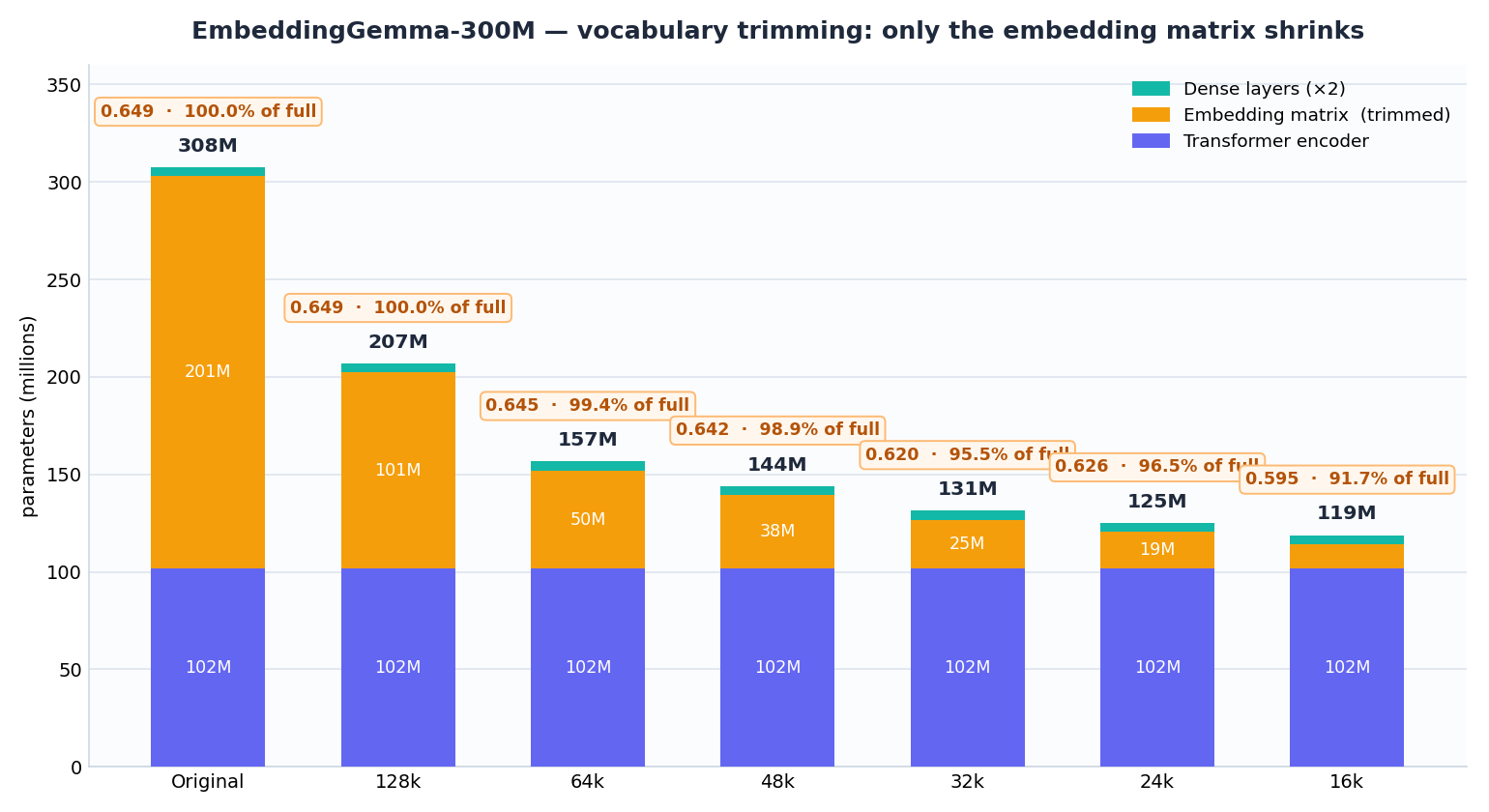
mean_22 score as a function of vocabulary size. The encoder is constant; only the embedding matrix shrinks.The result, first
Evaluated on MTEB-BR — the 22 native PT-BR tasks — with the transformer encoder and Dense heads identical at every vocab size; the only variable is the embedding matrix.
| Vocabulary | Parameters | MTEB-BR mean_22 | % of full |
|---|---|---|---|
| 16k | ~119M | 0.5950 | 91.7% |
| 24k | ~125M | 0.6263 | 96.5% |
| 32k | ~131M | 0.6201 | 95.5% |
| 48k | ~144M | 0.6418 | 98.9% |
| 64k | ~157M | 0.6453 | 99.4% |
| 128k | ~207M | 0.6491 | ≈100% |
| Full EG-300M | ~308M | 0.6490 | 100% |
Quality recovers monotonically above 32k. At 64k the trim reaches 99.4% of the full model’s score at 51% of the parameters — the sweet spot. The 128k model ties the full model within measurement noise (0.6491 vs. 0.6490). Below ~24k the model loses the fine-grained distinctions that retrieval and reranking depend on, so the score drops faster than the parameter count. The score being compared against — $0.6490$ for the full EmbeddingGemma-300M — is the same 22-task mean that model earns on the MTEB-BR leaderboard, which is what makes a compression claim like “99.4% of quality” checkable rather than rhetorical.
Method
Let $\mathcal{V}$ be the full vocabulary of the multilingual model, $|\mathcal{V}| = V$, and $d$ the embedding dimension. The embedding matrix is $E \in \mathbb{R}^{V \times d}$, where row $E_v$ is the embedding of token $v$.
1. Corpus-based frequency estimation
Given a target-language corpus $\mathcal{C}$, tokenize it with the original tokenizer $\tau$ and count how often each token appears:
$$f(v) = \sum_{x \in \mathcal{C}} \sum_{t \in \tau(x)} \mathbf{1}[t = v], \qquad v \in \mathcal{V}$$2. Vocabulary selection
Let $\mathcal{S} \subset \mathcal{V}$ be the mandatory special tokens (pad, bos, eos, unk, and high-frequency byte-fallback tokens). The trimmed vocabulary of size $K$ keeps the most frequent tokens plus the special set:
$$\mathcal{V}_K = \underset{v \,\in\, \mathcal{V} \setminus \mathcal{S}}{\text{Top-}K}\{f(v)\} \;\cup\; \mathcal{S}$$A contiguous re-indexing bijection $\sigma: \mathcal{V}_K \to \{0, \ldots, |\mathcal{V}_K|-1\}$ preserves the original relative order of token ids.
3. BPE merge consistency
A BPE vocabulary is an ordered list of merge rules $\mathcal{M} = \{(a_i, b_i) \to c_i\}$. A merge survives only when all three tokens do:
$$\mathcal{M}_K = \{(a, b) \to c \;\in\; \mathcal{M} \;\mid\; a \in \mathcal{V}_K \;\land\; b \in \mathcal{V}_K \;\land\; c \in \mathcal{V}_K\}$$This is the step most implementations overlook: keeping a merge whose product $c \notin \mathcal{V}_K$ makes the tokenizer emit a token id that no longer exists in the embedding matrix — silently producing garbage embeddings, or an index error at inference time.
4. Embedding submatrix extraction
The trimmed embedding matrix selects the surviving rows in the new index order:
$$E_K = E\bigl[\sigma^{-1}(0),\; \sigma^{-1}(1),\; \ldots,\; \sigma^{-1}(|\mathcal{V}_K|-1)\bigr]$$The encoder, pooling, and Dense heads are copied unchanged, giving $\theta_K = (E_K,\, \theta_\text{enc},\, \theta_\text{pool},\, \theta_\text{dense})$. For every surviving token, $E_K[\sigma(v)]$ is bit-for-bit identical to $E[v]$. No weight is modified, fine-tuned, or distilled.
5. Parameter reduction
Only the embedding term changes:
$$P = V \cdot d + P_\text{enc}, \qquad P_K = |\mathcal{V}_K| \cdot d + P_\text{enc}, \qquad \Delta P = (V - |\mathcal{V}_K|)\, d$$For EmbeddingGemma-300M ($V = 262{,}144$, $d = 768$, $P_\text{enc} \approx 107\text{M}$) trimmed to $K = 64{,}000$:
$$\Delta P = (262{,}144 - 64{,}000) \times 768 \approx 152\text{M parameters} \quad (-49\%)$$Why quality holds
Because the encoder is identical across all trim sizes, quality loss comes solely from tokenization changes for out-of-vocabulary tokens. As $K$ grows, coverage of the language’s actual token distribution approaches unity and the score converges to the untrimmed baseline:
$$\lim_{K \to V} \text{MTEB}(f_{\theta_K}) = \text{MTEB}(f_\theta)$$Empirically the convergence is fast: at $K = 64{,}000$ on Portuguese, $\text{MTEB}(f_{\theta_K}) / \text{MTEB}(f_\theta) = 99.4\%$.
Architecture
multilingual model                       language-trimmed model
+-------------------------+              +-------------------------+
| embed_tokens 262144x768 |  -- trim --> | embed_tokens  64000x768 |  ← only this shrinks
+-------------------------+              +-------------------------+
| transformer encoder     |  (unchanged) | transformer encoder     |
| pooling + Dense heads   |  (unchanged) | pooling + Dense heads   |
+-------------------------+              +-------------------------+
        ~308M params                             ~157M params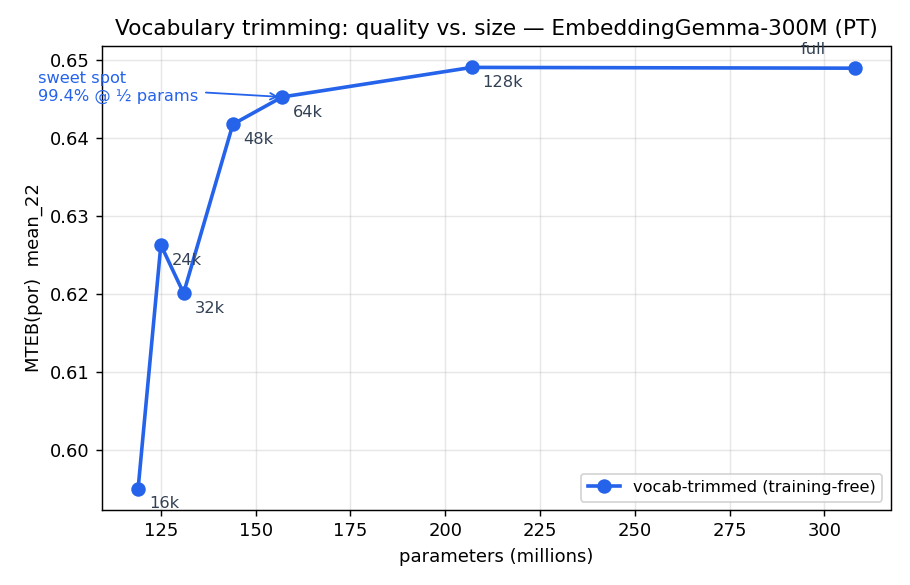
mean_22 versus parameter count. The 64k trim sits at the knee: nearly full quality at about half the parameters.Which models are worth trimming
The key metric is the embedding fraction $\rho = (V \times d) \,/\, P_\text{total}$ — the share of parameters that live in the embedding matrix and can therefore be removed. Models with small encoders and large multilingual vocabularies (over 200k tokens) are the best candidates.
| Model | $V$ | $d$ | Emb (M) | Total (M) | $\rho$ |
|---|---|---|---|---|---|
| sentence-transformers/LaBSE | 501,153 | 768 | 384.9 | 471 | 81.7% |
| intfloat/multilingual-e5-base | 250,002 | 768 | 192.0 | 278 | 69.1% |
| paraphrase-multilingual-mpnet-base-v2 | 250,002 | 768 | 192.0 | 278 | 69.1% |
| google/embeddinggemma-300m | 262,144 | 768 | 201.3 | 308 | 65.4% |
| intfloat/multilingual-e5-large | 250,002 | 1024 | 256.0 | 560 | 45.7% |
| BAAI/bge-m3 | 250,002 | 1024 | 256.0 | 568 | 45.1% |
| Qwen/Qwen3-Embedding-0.6B | 151,669 | 1024 | 155.3 | 596 | 26.1% |
| intfloat/e5-mistral-7b-instruct | 32,000 | 4096 | 131.1 | 7,111 | 1.8% |
The pattern is consistent: encoder or bi-encoder models with a multilingual tokenizer (XLM-RoBERTa = 250k; Google SentencePiece = 262k; LaBSE = 501k) concentrate parameters in the embedding matrix and yield the largest reductions. Decoder-only models (Mistral, Qwen, LLaMA) have small vocabularies relative to their encoder, so trimming barely helps.
Try it
pip install -r requirements.txt

python trim_vocab.py \
    --model google/embeddinggemma-300m \
    --corpus-config por \
    --vocab-size 64000 \
    --output ./embeddinggemma-pt-br
--corpus-config is the language code for the mining corpus (por, fra, deu, spa); pass --corpus-dataset to mine any other HuggingFace text dataset. A ready-made Portuguese build is on Hugging Face at tardellirs/embeddinggemma-pt-br.
What it is not
This is a compression method, not an enhancement. Trimming the vocabulary preserves quality; it does not improve it. Fine-tuning, layer pruning, and distillation from a larger teacher were all evaluated and each reduced MTEB-BR by 0.02–0.04 points. The base model is at its representational ceiling for the target language; trimming recovers deployment efficiency at no quality cost, but cannot exceed it. Validated on BPE tokenizers with byte-fallback (Gemma/EmbeddingGemma); the merge-filtering logic may need minor adaptation for other tokenizer families.
Vocabulary trimming is an ablation alongside MTEB-BR, not part of the benchmark ranking. The benchmark is what makes it measurable: without a native Portuguese score to compare against, “99.4% of quality” would just be a number.
Code, equations, and all seven data points: github.com/tardellirs/embedding-vocab-trimmer (Apache-2.0; trimmed models inherit the base model’s license — the example build follows the Gemma Terms of Use).